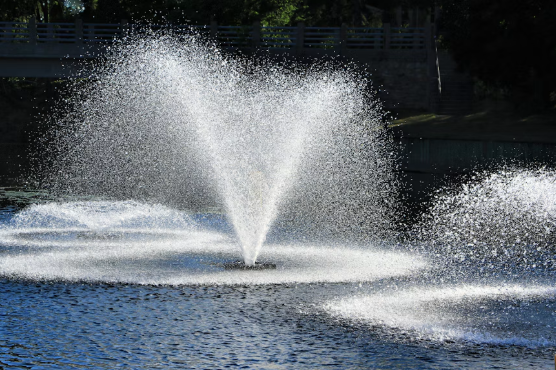

A still backyard pond can disappear into the view from a patio, even when the water looks clear. Margy Terpstra, a Wild Ones St. Louis chapter member, observes that moving water draws more attention because birds can see sunlight shifting across it and hear the splash.
A pond fountain won’t guarantee a busy gathering place, since birds also respond to the rest of the yard. Homeowners who want a water feature that supports birdwatching can browse best pond fountains for sale while deciding what kind of water movement suits their pond. The fountain should serve the habitat around it, not sit apart from it.
What Birds Notice
Birds notice moving water because its sound and motion stand out against a still pond. Terpstra’s observations on moving water and backyard birds describe sunlight flickering across the surface, splashing birds can hear, and birds coming closer to investigate.
From nearby shrubs, trees, and planting beds, a fountain gives a pond a changing look. Ripples reflect light differently as the day moves on, and a soft splash gives birds another sign that water is there. The spray needn’t be dramatic for the pond to appear active.
Terpstra describes moving water as oxygenated and fresh, too. The account comes from backyard habitat work, not a controlled bird study, so it does not promise that every bird will choose moving water. Homeowners can take a simpler point from it: birds can notice moving water more easily than a still surface.
See also: Competitive Swim Briefs: Fit, Fabric, and Performance Considerations for Swimmers
Habitat Around the Pond
A pond fountain belongs in a yard that offers more than water. The National Wildlife Federation’s habitat essentials guidance names food, water, cover, and places to raise young as the four parts of a wildlife-friendly space.
Cover includes the vegetation and shelter near a water source, where birds can pause before coming closer. Shrubs, native plants, and small trees help a pond feel connected to the rest of the yard instead of exposed in an open lawn. A fountain provides water, but it cannot offer food or shelter by itself.
Terpstra also notes that nearly all terrestrial bird species need water, whatever their diet. This helps explain why a pond may attract birds that never visit a seed feeder. Any birds that stop by will still rely on what the surrounding yard provides.
Running on a Routine
A steady operating schedule can give birds a familiar signal to investigate the pond. Terpstra says a bird bath dripper set to run at the same time each day may teach birds when to return. Its repeated dripping and moving water give them a predictable cue.
A pond fountain differs from a bird bath dripper, so this observation doesn’t show that every fountain will prompt the same behavior. Homeowners can nevertheless test the principle by running a fountain at a reliable time of day. If operation is random, birds are less likely to encounter the same sound and movement often enough to recognize a pattern.
Seasonal shifts in bird movement can also affect what homeowners observe at a pond. Terpstra says migrating warblers may respond to chickadees, which she calls an indicator species of healthy habitat, and may then come toward the water. A pond that grows busier during migration does not mean its fountain has changed. The surrounding habitat may also be attracting the birds.
Pump Fit and Flow
Choose a pump that can produce the intended fountain pattern without sending water over the pond edge. Gallons per hour measures how much water a pump moves in one hour, and its rating indicates the flow available to the fountain. More flow can increase surface movement, but a habitat pond does not need the tallest spray.
Head height is the vertical distance from the water surface to the fountain outlet that the pump must overcome. As head height increases, pump output drops, so a gallons per hour rating at zero lift alone cannot predict the fountain’s pattern. Measure the vertical lift, then check the pump’s flow information at that height before selecting a nozzle.
A submersible pump operates below the waterline, and its intake can collect pond debris without regular maintenance. Place the pump where you can reach it without trampling planted edges, and check the intake if the spray weakens. For bird viewing, a lower, steadier pattern may be preferable to water blown onto nearby soil or paving.
Fountain Placement
Place the fountain near cover, not simply where it creates perfect visual symmetry. When birds already perch nearby or pass through planting beds, they are more likely to notice the moving water from familiar resting spots.
A centered fountain may suit a formal pond, but watching wildlife calls for another consideration: where can birds approach without crossing a broad, bare stretch of yard? View the pond from a bird’s perspective. Existing shrubs, a planted edge, or a small tree can help determine the best place for the fountain.
A pond also needs open space for its caretaker. Keep part of the water visible from a path or patio, so floating leaves, changes in the spray, and other shifts are easy to spot during routine yard work. Planting densely around every edge can make the pond harder to observe and maintain.
What to Do Next
Start by watching the pond before choosing a fountain position. Notice where birds perch, which side of the yard has usable cover, and when sunlight reaches the water while you’re outside. Those details will tell you more about placement than a perfectly centered view from indoors.
Choose a fountain that keeps the water visibly moving, place it near existing cover, and use an operating routine you can keep up with. A backyard pond becomes more inviting to birds when its moving water belongs to the habitat around it. Watch the yard for a few days, then mark the fountain location near the cover birds already use.