
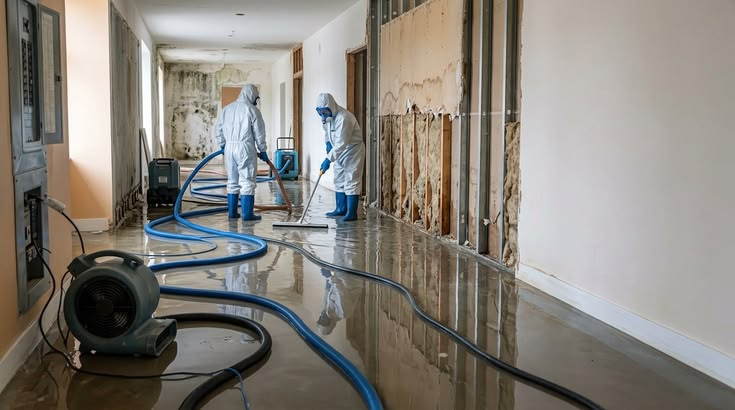

In single occupancy homes, water from a burst pipe will be restricted to one property. However, in multiple occupancies such as apartments, townhouses and condos, water leaks can quickly spread across multiple units.
Swift water damage restoration in Centennial Colorado can avoid further damage if a commercial property is leaking. Our expert water damage specialists are able to manage extensive water ingress and also produce detailed reports on areas of water damage at Restoration Logistics Centennial.
Why Does Water Damage Spread so Quickly in multiple Occupancies?
Due to shared services within multiple occupancy buildings, including central pipework and sub-floor construction, water damage in one location can quickly lead to damage across multiple units.
If there is a supply pipe burst on higher levels of a building, water can run down through the floorboards and cause damage to ceiling plaster lower down. Many modern multiple occupancy buildings also have sound proofing and fire proof drywall so water can get stuck within hidden areas of the building.
This can cause increased damage and costs. If a tenant on a lower floor notices discolouration and blistering on their ceiling due to water damage, it could mean that water has been leaking for several days through the ceilings above.
If water has become trapped in these walls, without quick drying and extraction, mold will start to grow in multiple locations within the building. This means that a simple plumbing issue can quickly turn into long term displacement for many tenants.
See also: How Can Industrial Odour Control Units Improve Workplace Air Quality?
Ways to Prevent Water Damage in Multiple Occupancies
While it is impossible to completely prevent plumbing issues in multiple occupancies, regular maintenance throughout the building will drastically reduce the risk of serious water damage.
Upgrade water supply hoses: Every 5 years replace your rubber water supply hoses (washing machines, dishwashers and toilets) with braided stainless steel ones.
Fit smart leak detectors: Fit Wi-Fi enabled leak detection devices under hot water cylinders, sinks and washing machines to immediately send you a notification on your phone, or to automatically shut off the water supply.
Do annual checks on common pipework: Have annual camera checks and pressure tests done on old pipework, drainage and boiler systems within the building.
Maintain minimum heat in unoccupied properties: Require unoccupied properties to have a minimum temperature of 55 degrees Fahrenheit in freezing weather. This will help avoid burst pipes.
Immediate Containment Protocols for Shared Structures
To limit water spreading in a multiple occupancy building, residents and managers must act quickly. This will reduce the spread of water between properties and ensure dry areas in the building remain unaffected.
Locating Isolation Valves and Building Shutoffs
All residents and building managers should be aware of where the shut off valve is in their individual property and for the main pipework in the building. Newer apartments/condominiums should have individual shut off valves in utility rooms, laundries or under kitchens.
If residents are unable to locate the shut off valve in their property, or they are out of the property when water damage occurs, building maintenance must immediately shut off the pipework supplying the entire section of properties in question, and inform those affected.
Establishing Moisture Barriers and Negative Air Zones
Once the source of water damage in the pipework has been stopped, trained technicians will use thermal imaging cameras and moisture detecting devices to identify the affected areas. As water will tend to spread horizontally across concrete flooring and sub flooring, water damage barriers and zip wall systems will be installed to stop water from spreading to dry areas.
Using water damage restoration in Centennial Colorado, technicians will fit industrial dehumidifiers, negative pressure systems and targeted drying systems to dry hidden water damage in walls without removing undamaged walls next to the damaged area.
Navigating Liability and Insurance Coverage
Alongside the issue of actually removing water, deciding who should pay for remediation can be complicated. This is affected by where the water entered the building, what led to the problem and the association/lease by-laws.
Master Policies vs. Individual Unit Owner Policies
Within a community of condominiums or townhouses there is usually a master policy taken out by the Home Owners Association (HOA) and also an HO-6 policy which is individually owned. The master policy insures for communal areas including the roof, walls, corridors and main water pipes.
An owner’s HO-6 insurance includes furnishings, goods and fitted units. It also provides cover for the internal water pipes associated only with that unit. Within rented apartments, the landlord will have business insurance which insures the building and tenants will have renters insurance for their own goods.
Negligence, Sudden Failures, and Governing Bylaws
Insurance companies usually differentiate between accidental and avoidable damage. Should a washing machine hose for example suddenly rupture, despite appropriate servicing, each party involved will generally make a ‘no-fault’ claim through their insurer.
Nevertheless, if a water problem has been caused by an owner’s avoidable behaviour – such as failing to repair a recognised pipe issue, failing to close windows in cold weather or undertaking self-help plumbing work without permission, then this owner and their own insurance may be legally bound to pay for the repair to all of the lower units.
Essential Documentation for Smooth Multi-Unit Claims
As more than one insurance assessor is involved in multi-unit water damage, there are also multiple deductibles and differing determinations of liability, good record keeping is key:
Identify the source: Secure a formal report from a plumber detailing which pipe, piece of equipment or communal area was at fault.
Document evidence: Take photographs and film of liquid build-up, ceiling discolouration and damaged goods in all affected units prior to removal of items.
Monitor humidity: Record daily humidity information and produce heat maps to illustrate the extent to which water had travelled through both walls and under floors.
Receive detailed invoices: Ask water damage restoration in Centennial Colorado to provide separate detailed cost statements for each unit.
Conclusion
Multi-unit water problems are a challenge not just for a building’s defence mechanisms, but also for the collaboration between residents, landlords and the Home Owners Association. Knowledge of master, HO-6 and by-law provisions avoids expensive legal issues arising.
